

A bottle’s total milligrams, liquid volume and serving size describe different things. This guide shows you how to read CBD oil labels, calculate milligrams per milliliter and compare strengths without guessing.
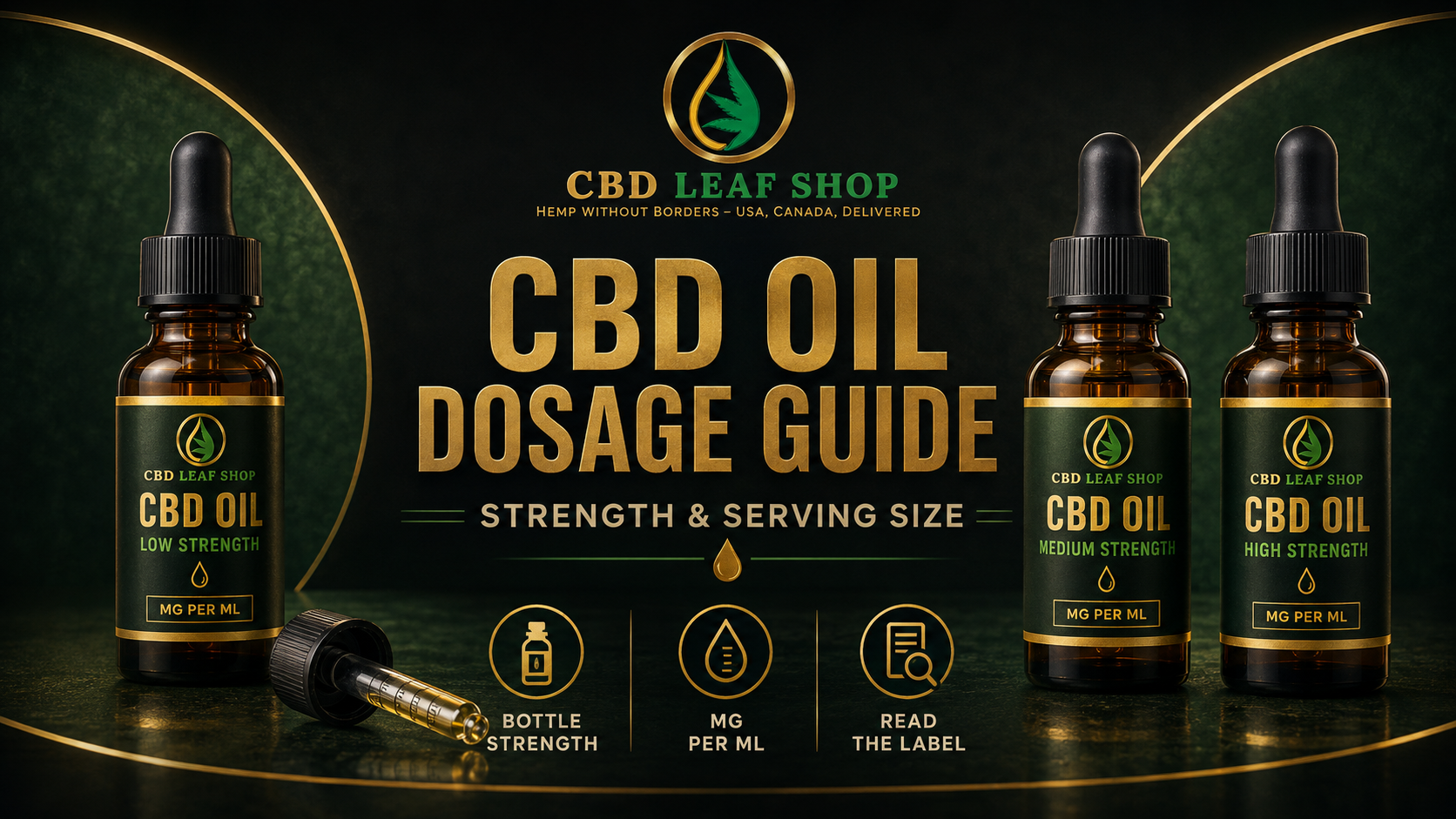
Compare the CBD amount, bottle volume and laboratory report—not the front-label number alone.
CBD oil labels often display one large number—such as 500 mg, 1,000 mg or 2,000 mg. That number usually refers to the total advertised CBD in the entire bottle, not the amount in every dropper. To compare two oils correctly, you also need the bottle volume and the amount delivered by the marked dropper or stated serving.
This guide explains label mathematics and product comparison. It does not recommend a personal medical dose. The FDA says most nonprescription CBD products have not been evaluated to determine a proper dosage, possible drug interactions or many other safety questions. If you are unfamiliar with CBD formats, start with our complete beginner’s guide to CBD products before comparing the CBD oil collection.
CBD Oil Strength, Serving Size and Dosage Are Not the Same
Bottle strength
The total advertised amount of CBD in the complete bottle, usually expressed in milligrams.
Concentration
The amount of CBD in each milliliter of liquid, commonly written as mg/mL.
Serving size
The volume described on the label, such as 0.5 mL or 1 mL. It is not automatically a personal medical recommendation.
The word “dosage” is often used casually to mean any of these numbers, which creates confusion. A stronger bottle contains more CBD in the same volume than a weaker bottle. A larger bottle can contain more total CBD while still having the same concentration as a smaller bottle.
How to Calculate CBD Oil Strength in mg/mL
Find the total milligrams of CBD and divide that number by the bottle’s liquid volume in milliliters.
If the marked dropper holds 1 mL when filled to its 1 mL line, that full measured volume would contain approximately the same number of milligrams as the mg/mL concentration. A 0.5 mL measured volume would contain half that amount. Do not assume every dropper holds exactly 1 mL—read its markings and the product instructions.
| Advertised total CBD | Bottle volume | Calculated concentration | What the number means |
|---|---|---|---|
| 500 mg | 30 mL | About 16.7 mg/mL | Each measured milliliter contains approximately 16.7 mg CBD. |
| 1,000 mg | 30 mL | About 33.3 mg/mL | Twice the concentration of the 500 mg example in the same bottle size. |
| 2,000 mg | 30 mL | About 66.7 mg/mL | Four times the concentration of the 500 mg example. |
| 1,000 mg | 60 mL | About 16.7 mg/mL | The same concentration as 500 mg in 30 mL, but twice the total liquid. |
These examples demonstrate calculations only. They are not recommended serving amounts. Always calculate from the exact label and confirm the advertised cannabinoid amount against the relevant batch report.
How to Read a CBD Oil Label Step by Step
- Find the total CBD amount. Confirm that the headline number represents CBD rather than total hemp extract, total cannabinoids or another marketing measurement.
- Find the bottle volume. This normally appears in milliliters and sometimes fluid ounces.
- Calculate mg per mL. Divide total CBD by total milliliters if the concentration is not printed clearly.
- Read the stated serving size. Note whether it is given as a measured volume, dropper line or another unit.
- Check the ingredient list. Identify the carrier oil, flavorings and any additional cannabinoids or ingredients.
- Match the batch COA. Confirm the product identity, lot number, cannabinoid results and relevant contaminant panels.
Be careful when one number is described as “hemp extract” rather than CBD. A bottle may contain a stated mass of extract while only part of that extract is CBD. The product details should identify the actual CBD content separately enough for a useful comparison.
Droppers, Drops and Measured Volume
A graduated dropper may show lines such as 0.25 mL, 0.5 mL, 0.75 mL and 1 mL. Use those lines rather than estimating by eye. The physical size of the rubber bulb or glass tube does not prove the amount of liquid delivered.
Counting individual drops is less precise because drop size can change with the dropper tip, oil thickness, temperature and handling angle. Online statements that every milliliter always equals a fixed number of drops are convenient estimates, not universal measurements. When accuracy matters, use the marked volume supplied with the product.
If the label and dropper markings disagree, do not guess. Ask the seller or manufacturer to clarify the intended measurement before using the product.
Does Full-Spectrum, Broad-Spectrum or Isolate Determine Strength?
No. Spectrum describes the intended cannabinoid profile, while strength describes concentration. A full-spectrum oil can be low or high strength, and the same is true for broad-spectrum and isolate products.
- Full-spectrum: is intended to retain a range of hemp compounds and may include measurable THC within applicable limits.
- Broad-spectrum: is intended to contain multiple hemp compounds with THC removed or reduced, but the batch report should confirm the actual result.
- CBD isolate: uses highly purified CBD and is not intended to provide the broader cannabinoid profile of the other formats.
Read our full-spectrum vs. broad-spectrum CBD oil guide for a closer comparison. Spectrum language does not guarantee that a product is THC-free or incapable of affecting a drug test; check the laboratory result and understand that no consumer product can guarantee a particular testing outcome.
Use the COA to Confirm the Label
A certificate of analysis can help you check whether the measured cannabinoids reasonably support the advertised strength. Begin with the CBD Leaf Shop Lab Tests and COAs page and our guide explaining how to read CBD lab results and COAs.
- Match the product name and lot or batch number.
- Check the sample, test and report dates.
- Confirm the result’s unit, such as mg/g, mg/mL or percent by weight.
- Review CBD, CBDA, delta-9 THC and THCA rather than one highlighted value.
- Separate “ND” or not detected from absolute zero.
- Confirm which contaminant panels were actually completed.
A small difference can result from analytical uncertainty, rounding or batch variation. A major unexplained difference, mismatched batch or missing report deserves a question before purchase.
Why There Is No Universal CBD Oil Dose
People may respond differently because products, concentrations, other ingredients, health conditions and medication use vary. The FDA notes important unanswered questions about how much CBD creates specific risks and what happens with sustained daily use. It also warns that CBD can interact with medications, affect alertness and has been associated with liver injury and other side effects.
Before considering a CBD product, discuss it with a qualified healthcare professional or pharmacist when appropriate—especially if you take prescription or over-the-counter medicines, drink alcohol, have a medical condition, are pregnant or breastfeeding, are preparing for surgery, or are considering CBD for a child.
A Practical CBD Oil Comparison Checklist
- Total CBD: the actual advertised CBD in the bottle, not just total extract.
- Bottle volume: the liquid amount in milliliters.
- Concentration: total CBD divided by total volume.
- Measured serving: the label instruction and marked dropper volume.
- Spectrum: full-spectrum, broad-spectrum or isolate, confirmed with testing.
- Ingredients: carrier oil, flavorings and additional active ingredients.
- Batch COA: matching potency and relevant contaminant results.
- Professional questions: possible medication interactions, health considerations and safe use.
Frequently Asked Questions
Does 1,000 mg mean every dropper contains 1,000 mg of CBD?
No. It usually means the complete bottle advertises 1,000 mg. Divide that amount by the bottle volume to calculate the approximate mg per mL.
Is a higher-strength CBD oil automatically better?
No. Higher strength means more CBD per measured volume. Product suitability, ingredients, testing, accuracy and individual safety questions matter more than choosing the largest number.
Is one full dropper always 1 mL?
No. Some droppers are marked to 1 mL, while others have different capacities or no reliable markings. Read the supplied dropper and product instructions.
How many drops are in 1 mL?
There is no universal exact number. Drop size varies with the dropper, liquid and handling. A graduated milliliter marking is more reliable than counting drops.
Can the COA tell me the right personal dose?
No. A COA reports laboratory measurements for a sample. It can help verify potency and selected quality panels, but it does not determine an appropriate personal dose.
Can CBD oil interact with medication?
Yes. FDA and NIH information warns that CBD may interact with medications. Discuss your complete medicine and supplement list with a healthcare professional or pharmacist.
- U.S. FDA: Consumer Information About Cannabis-Derived Products Including CBD
- NIH/NCCIH: Cannabis and Cannabinoids—What You Need to Know
- NIH/NCCIH: How Medications and Supplements Can Interact
This article is general educational information. It does not provide medical advice, recommend a personal dose or replace the product label, current regulations or guidance from a qualified professional.
Compare CBD Oils More Clearly
Check the total CBD, bottle volume, concentration, ingredients and relevant laboratory report before choosing a product.
Browse CBD OilsAsk a Product Question